

Contact · Newsletter · DEUTSCH
Want to cut development time by 40%? Find out how in a personalized live demo with our lead developer.
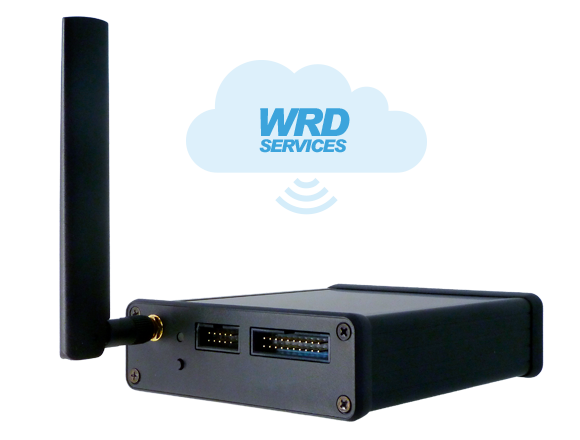
The WRD/Probe enables remote access to targets in the field via a GDB debug session and a serial console. This allows developers to begin field testing much earlier, save up to 40% in development time, and achieve a faster time-to-market.
In addition to firmware updates, reset, and power on/off, the target's energy consumption can also be precisely monitored – ideal for battery-powered devices. The multi-target remote debugging option also enables secure remote access to all instances of a wireless IoT application.
The WRD/Probe automatically establishes an encrypted end-to-end tunnel via mobile communications between the development environment and the target in the field, enabling monitoring, flashing, and debugging. This means that embedded development and after-sales service are independent of location and infrastructure throughout the entire product lifecycle.
In addition, the WRD/Probe provides embedded developers with a complete OTA infrastructure without the target itself having to be OTA-capable. This allows field testing on real hardware in the actual application environment to begin earlier – for faster time-to-market with minimal travel expenses.
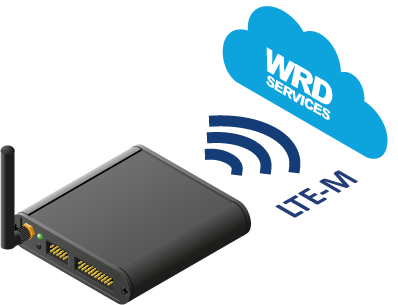
After switching on, the WRD/probe connects automatically to the SSV rendezvous server (WRD Services) via LTE-M thanks to the pre-installed SIM card incl. traffic.
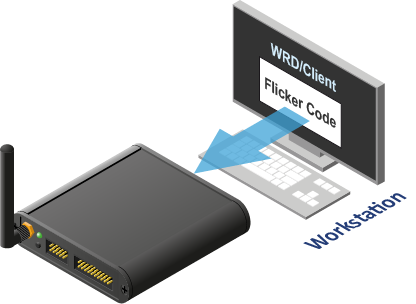
The workstation is then paired with the WRD/Probe. To do this, the WRD/Client on the workstation generates a flicker code with a key, which is read in via the photo transistor on the WRD/Probe.
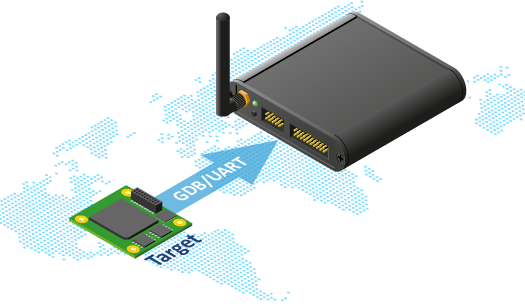
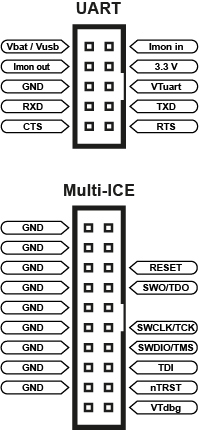
Finally, the target device is connected to the WRD/Probe via GDB or UART, and debugging can begin! It doesn't matter whether the field test takes place just around the corner or hundreds of kilometers away; all that is required is mobile network coverage.
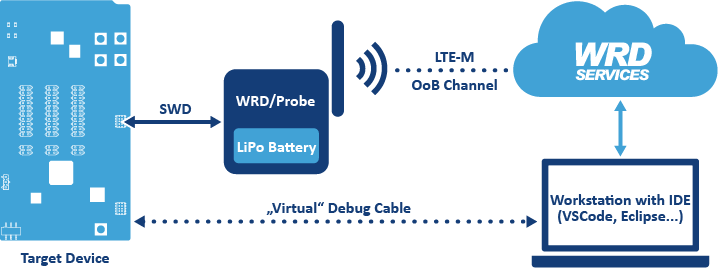
The WRD/Probe was specially designed for field testing of (wireless) IoT devices and embedded systems under real-world conditions.
The development of IoT devices poses many challenges: The MCU and embedded operating system, various sensors, RF communication, and, in some cases, battery power supply make an IoT device a highly complex system that can only be comprehensively tested to a very limited extent within a development environment using simulated environmental parameters and largely ideal environmental conditions.
For these reasons, numerous debugging tasks must be performed directly in the application environment using a field or end-to-end (E2E) test. For this, the WRD/Probe has a battery life of up to 12 months without recharging, depending on the actual usage and the connected target. This also makes long-term field tests possible without any problems.
It can be used anywhere in the world where there is an LTE-M connection and connects fully automatically to your development environment via a rendezvous service on the Internet (WRD Services). With the WRD/Probe, embedded developers get a complete OTA infrastructure without the target itself having to have OTA capability.
It uses common standards and offers a GDB interface that integrates seamlessly into your familiar development environment such as VSCode or Eclipse. This creates a “virtual” debug cable, so to speak.
Starting the build process, setting breakpoints, checking variables, etc. remains unchanged, so you can maintain your usual workflow.
Connecting Devices via a Serial RS232 Interface
With the Probe/232 adapter (an optional accessory), any device with a standard RS232 interface can be easily connected to the WRD/Probe.
This provides, for example, a quick and easy way to receive IoT telemetry data or to remotely operate a Linux console.
The adapter converts the WRD/Probe’s UART signals to standard RS232 voltage levels, enabling direct connection to a serial interface.
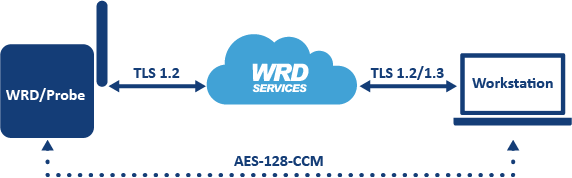
When two communication partners connect to each other via TLS over a cloud on the Internet, it is often overlooked that the cloud acts as a TLS server for both partners, meaning that two independent TLS sessions exist. This means that the "interrupted" TLS tunnel does not provide continuous end-to-end security and the data within the cloud is unencrypted.
In order to offer users maximum security, WRD Services do not only use a classic TLS tunnel between the WRD/Probe and the workstation. The data packets in the TLS tunnel are also encrypted using the AES-128-CCM method and protected against manipulation by an integrity check, thus providing additional security.
Since the AES key is only exchanged directly between the WRD/Probe and the workstation during pairing, without the involvement of WRD Services, and is therefore only known to these two endpoints, genuine end-to-end security is achieved.
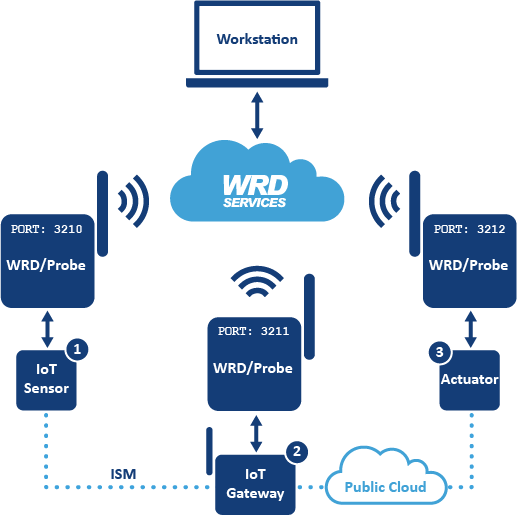
This is how multi-target remote debugging helps in the development of (wireless) IoT applications.
The figure on the left illustrates a typical IoT application in which a wireless sensor ❶ periodically or event-driven transmits measurement data via ISM radio frequency (e.g., 868/915 MHz or 2.4 GHz) to an IoT gateway.
The IoT gateway ❷ forwards the sensor data to a cloud service via the Internet, with or without data preprocessing, depending on the application.
The public cloud provides other applications (such as a smartphone app) or an actuator ❸ with information based on the data from the IoT sensor. Conversely, software updates, etc., are transferred from the public cloud to the IoT gateway or IoT sensor as needed.
Technical problems in such applications manifest themselves, for example, in the form of incorrect information in an app/website or malfunctioning of the actuator.
In order to diagnose the causes of such problems, a developer needs extensive (remote) access to all application instances involved, which is easily possible with WRD/Probe and multi-target remote debugging.

What makes the WRD/Probe so special compared to other debuggers, and how does it specifically support embedded developers on wireless IoT projects?
Our lead developer, Jürgen Fitschen, would be happy to show you in a personalized live online demo – using a real-world example – how we were able to save about 40% in development time, what capabilities and benefits the WRD/Probe offers, and how easy remote debugging is with it.
Simply select your preferred date and time.
You can order a WRD/Probe using these ways.
For business customers only!
Our product offerings are intended exclusively for companies, businesses, universities, skilled trades businesses, government agencies, and self-employed professionals. Sales to consumers are not permitted. Contracts with private individuals or end consumers will not be entered into.
Thank you for your understanding!
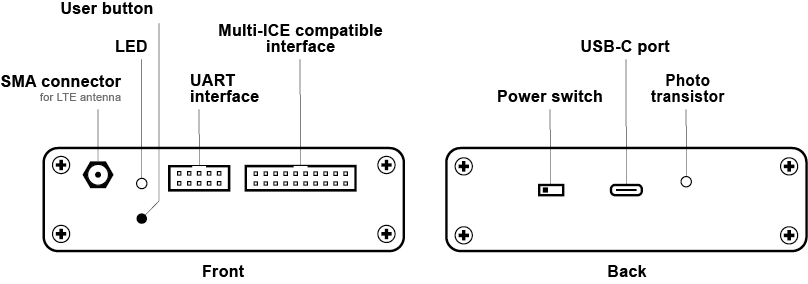
Data sheet (PDF)
Hardware Reference (PDF)
First Steps (GitHub)
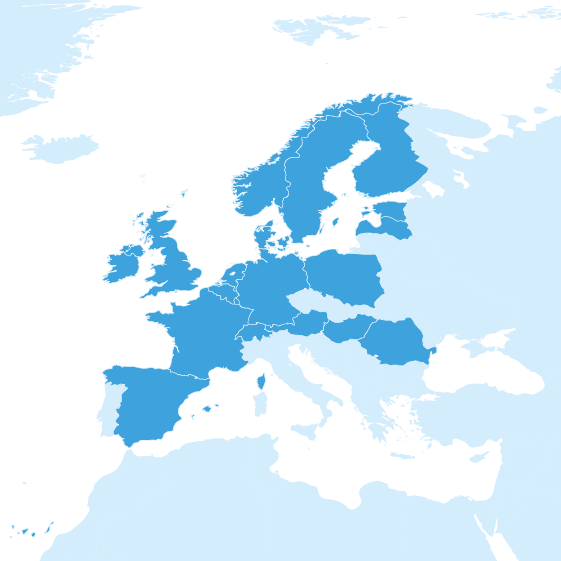
Please note: Coverage for other regions on request.
SSV SOFTWARE SYSTEMS
Dünenweg 5
30419 Hannover
Phone: +49(0)511 · 40 000-0
Fax: +49(0)511 · 40 000-40
© 2026 SSV SOFTWARE SYSTEMS GmbH // All rights reserved.
ISO 9001:2015


